rishi-vedula-mridangam-portfolio
Lesson 5: Rupaka Tala
What is Rupaka Tala?
Rupaka Tala is an important rhythmic cycle in Carnatic music.
It has a structured pattern that helps maintain balance and timing within compositions and practice exercises.
In this lesson, I practiced rhythm patterns based on Rupaka Tala and focused on maintaining correct alignment within the cycle.
Tala Structure
Rupaka Tala is commonly practiced as a 3-beat or 6-beat cycle depending on structure and speed.
Example structure:
1 2 | 3 4 | 5 6
Each pattern must align correctly within the tala and repeat with consistency.
Original Handwritten Notes
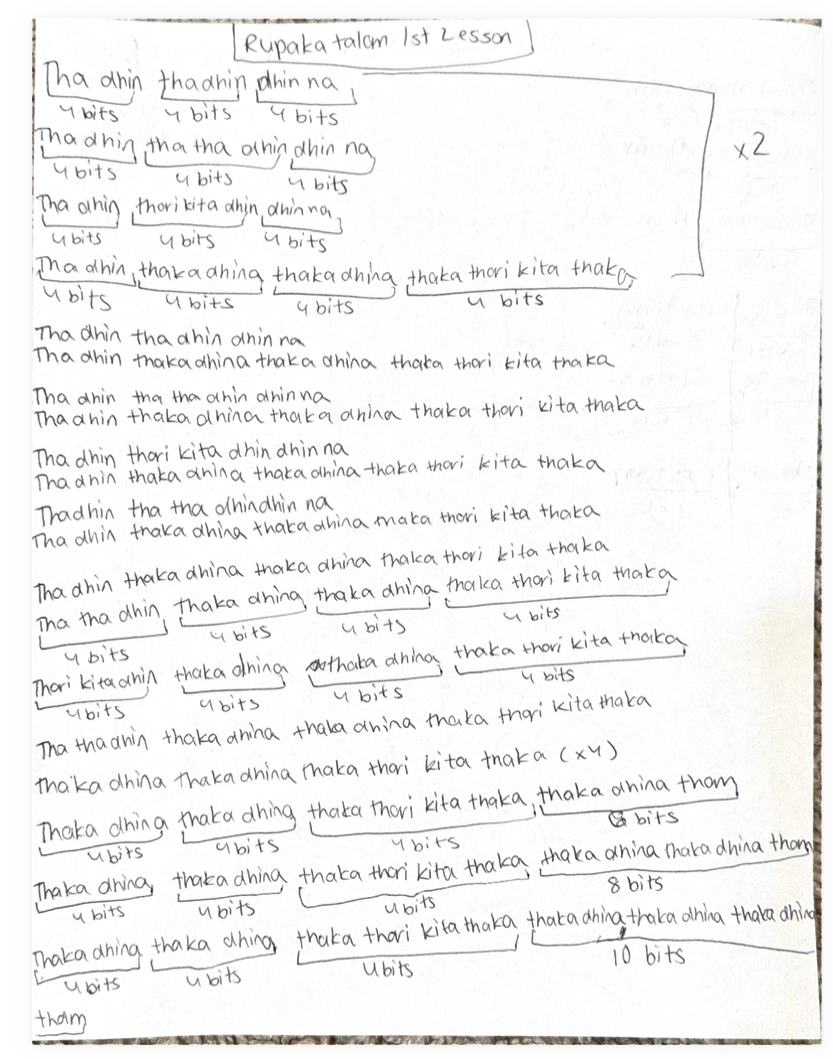
These are my original handwritten practice notes from class.
Download Original Notes (PDF)
Patterns I Learned (typed from my notes)
This Rupaka Tala lesson begins with a repeated phrase:
Thaka dhina thom (4 beats)
This phrase is played three times:
4 + 4 + 4
After this, a shorter grouped phrase follows:
Tha dhe | kita thom
2 beats 2 beats
This section is repeated as part of the structured sequence.
Important:
In this lesson, the vertical line ( | ) represents a 2-matrai pause before continuing.
This pause must be counted carefully to maintain alignment with the tala cycle.
The full structure must resolve correctly at the starting point of the cycle after accounting for:
- repetition
- grouped phrases
- pause
Understanding the Rupaka Tala Structure
While practicing Rupaka Tala, I noticed that the grouping feels different from Adi Tala because of its structure.
Common groupings include:
- 3 + 2 + 2
- or a flowing 6-beat structure
Even though the grouping feels different, the cycle must remain balanced and complete before repeating.
This helped me understand how different tala structures create different rhythmic flow and balance.
How the Pause Affects the Structure
One important part of this lesson is the 2-matrai pause.
Even though no syllable is played during the pause, it must still be counted as part of the total structure.
This means rhythm includes both:
- sound
- controlled silence
If the pause is not counted correctly, the final landing will not align with the tala cycle.
This showed me that structure in rhythm includes both action and intentional gaps.
Thinking in Cycles and Groupings
Practicing Rupaka Tala required careful counting and repetition.
I noticed that:
- grouping helps maintain structure
- repetition improves consistency
- alignment ensures correct rhythm flow
Each completed cycle reinforces timing and structural awareness.
Early Connections I Notice (Patterns & Logic)
Rupaka Tala involves repeating structured cycles.
Maintaining rhythm requires:
- counting
- grouping
- consistent repetition
- correct cycle completion
These ideas are similar to pattern-based thinking where structure and timing must remain consistent.
How I Structured This Rupaka Lesson
While practicing this lesson, I began breaking each phrase into counted units such as 4-beat groupings.
This helped me clearly see:
- how long each phrase is
- how phrases combine into larger sequences
- how repetition changes total length
- how structure must stay aligned with the tala cycle
Instead of memorizing only by sound, I started thinking in counted groupings.
This made it easier to predict whether a pattern would stay balanced within the cycle.
Repetition and Scaling
In this lesson, some patterns repeat multiple times.
For example:
- certain grouped phrases are played ×2
- others repeat ×3
When a phrase repeats, I must calculate:
phrase length
× number of repetitions
= total structure length
If the repeated structure becomes too long or too short, it will not align correctly with the tala cycle.
This showed me that repetition requires planning and calculation, not just memorization.
Expanding the Structure
As the lesson progressed, the grouped phrases began expanding.
Some sections stayed at:
- 4-beat groupings
Others expanded into:
- 8-beat groupings
- 10-beat groupings
This showed me that rhythmic structure can grow while still maintaining balance.
When structures become longer, it becomes more important to:
- track totals
- maintain alignment
- predict where the cycle resolves
This required stronger concentration and planning across longer sequences.
Planning the Resolution
In Rupaka Tala, every pattern must resolve correctly within the cycle.
Before playing, I began thinking about:
- how long each grouped phrase is
- how repetition changes the total
- where the final landing occurs
- whether the structure remains balanced
If the total grouping does not align correctly, the pattern must be adjusted.
This required prediction and careful counting before execution.
Structural Logic I Observed
This lesson helped me notice several structural ideas.
Mathematical thinking
- grouping numbers into fixed units
- scaling structures through repetition
- tracking totals across sequences
- adjusting patterns to maintain balance
Logical / computational thinking
- repeated sequences behave like loops
- grouped phrases act like building blocks
- larger structures are formed from smaller units
- correct resolution is required before repeating
Rupaka Tala helped me see how structure can grow while still following clear rules.
What This Helped Me Realize
Practicing Rupaka Tala helped me become more aware of how structure changes as patterns grow longer.
When sequences expand or repeat, I must think ahead and track totals carefully to maintain alignment.
This strengthened my ability to:
- think in grouped units
- track repetition and scaling
- predict resolution points
- maintain structure across longer sequences
I began to see rhythm not just as sound, but as a structured system that grows while staying balanced.
Structural Breakdown
First phrase: 4 + 4 + 4
Transition phrase: 2 + 2
Pause: 2 matrais
Total structure must be tracked carefully so the pattern lands correctly on samam.
This requires careful counting before playing.
Where This Is Leading
As I continue learning more tala structures and korvais, I want to understand how rhythm systems scale and stay structured even as patterns become more complex.
Over time, I hope to connect these ideas more clearly with:
- mathematical thinking
- system design
- real-world structured problem solving
This is an ongoing learning process, and I plan to keep documenting what I observe and understand.
Music, Math, and Computer Science Connection
This lesson connects to mathematical and computational thinking.
See full connections here:
➡️ Music → Math → Computer Science Connections