rishi-vedula-mridangam-portfolio
Lesson 7: Mishra Chapu
What is Mishra Chapu?
Mishra Chapu is a common chāpu tāla in Carnatic music.
It has an uneven internal grouping, which creates a distinct rhythmic flow and requires careful counting to stay aligned.
In this lesson, I practiced Mishra Chapu patterns by grouping counts (instead of only memorizing syllables) so I could land correctly at the end of each cycle.
Tala Structure
Mishra Chapu is typically counted as 7 beats, often grouped as:
3 + 2 + 2
Count example (beats): 1 2 3 | 4 5 | 6 7
How I Counted It in This Lesson (the way my notes show)
In my handwritten notes, I grouped patterns using “bits” (counts).
A common way to practice Mishra Chapu is to treat each beat as 2 counts, so the full cycle becomes:
14 counts (matrais) grouped as:
6 + 4 + 4 (same as 3+2+2 beats)
In my notes, I sometimes wrote the last two groups together as 6 + 8 (because 4 + 4 = 8).
Original Handwritten Notes
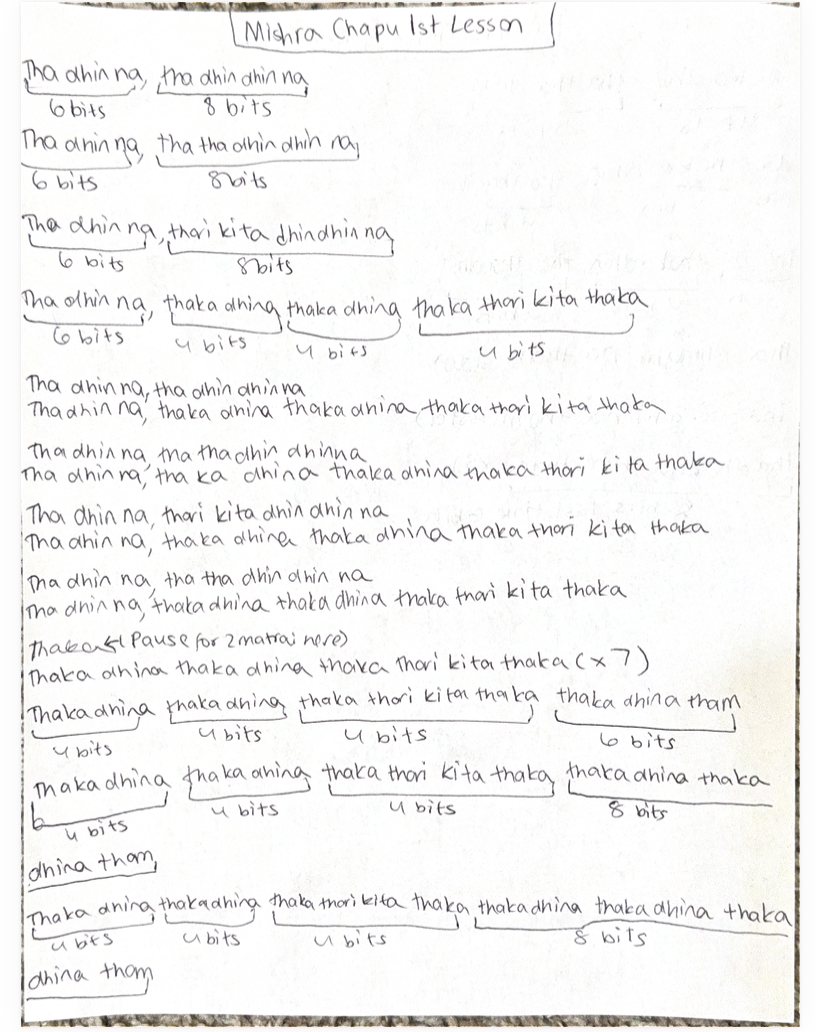
These are my original handwritten practice notes from class.
Download Original Notes (PDF)
Patterns I Learned (typed from my notes)
Below are the patterns as I wrote them, with the grouped counts I used to stay aligned.
A) Core 6 + 8 patterns (14 total)
These fit one full Mishra Chapu cycle when counted as 14:
- Tha dhin na (6) + Tha dhin dhin na (8)
- Tha dhin na (6) + Tha tha dhin dhin na (8)
- Tha dhin na (6) + Thori kita dhin dhin na (8)
B) Building longer phrases using smaller blocks
Here I combined multiple smaller blocks to build longer flowing sequences:
- Tha dhin na (6) + Thaka dhina (4) + Thaka dhina (4) + Thaka thori kita thaka (4)
Note: This is a longer build-up pattern. While playing, I still keep checking where I am inside the Mishra Chapu cycle using grouped counts.
Pause Note (important in my notes)
In my handwritten notes I marked a pause and wrote that it is:
Pause = 2 matrais
Even though no syllable is played during the pause, it must still be counted.
This helped me understand that rhythm includes both:
- sound
- controlled silence
If I miss the pause count, the pattern will shift and the ending will not land correctly.
Thinking in Groupings and Cycles
Mishra Chapu reinforced that grouping is the key.
Instead of counting straight 1–7, thinking in:
- 3 + 2 + 2 (beats)
or - 6 + 4 + 4 (counts)
helps me stay aligned and repeat patterns consistently.
How I Structured This Lesson
While practicing, I treated phrases like building blocks:
- 6-count blocks (the “3-beat” part)
- 4-count blocks (the “2-beat” parts)
- 2-count pauses (when used)
This made it easier to:
- track where I am in the cycle
- predict the landing
- keep consistency across repetition
Early Connections I Notice (Patterns & Logic)
Practicing Mishra Chapu feels similar to structured logic where:
- grouping keeps the system organized
- repetition behaves like a loop
- pauses behave like controlled timing gaps
- the full sequence must resolve correctly before repeating
What This Helped Me Realize
Mishra Chapu taught me that an “uneven” structure can still be very stable if I:
- group correctly
- count consistently
- track totals across blocks
- include pauses in the total structure
This improved my timing and helped me think of rhythm as a structured system.
Music, Math, and Computer Science Connection
This lesson connects to mathematical and computational thinking.
See full connections here:
➡️ Music → Math → Computer Science Connections