rishi-vedula-mridangam-portfolio
Lesson 9: Kanda Chapu
What is Kanda Chapu?
Kanda Chapu is a chapu tala in Carnatic music known for its uneven and flowing rhythmic structure.
It follows a 5-beat cycle, typically grouped as:
2 + 3
Because of this uneven grouping, it feels different from symmetrical talas and requires strong internal counting.
In this lesson, I practiced structured phrases in Kanda Chapu and focused on:
• internal grouping
• counting accuracy
• alignment across cycles
• controlled pauses
Tala Structure (Kanda Chapu)
Kanda Chapu is commonly grouped as:
2 + 3
Count example:
| 1 2 | 3 4 5 |
The first 2 counts create a short entry, followed by a longer 3-count flow.
Each pattern must complete the full 5-beat cycle before repeating.
Original Handwritten Notes
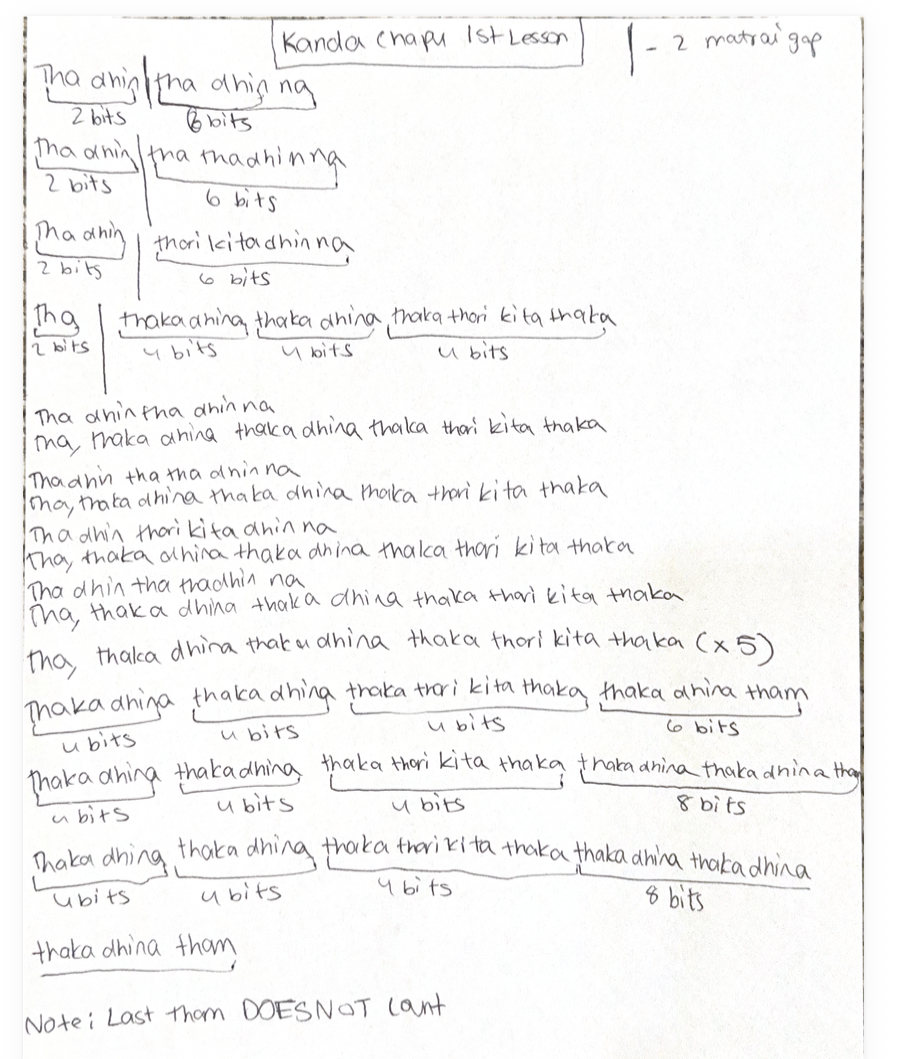
These are my original handwritten practice notes from class.
Download Original Notes (PDF)
Patterns I Learned (typed from my notes)
This lesson begins with short entry phrases:
Tha dhin (2 counts)
Tha dhin na (3 counts)
2 + 3 structure
Additional variations:
| Tha dhin | Tha dhin na |
| Tha dhin | Tha tha dhin na |
| Tha dhin | Thori kita dhin na |
Each phrase must maintain the 2 + 3 internal grouping.
Expanded Structured Section
The lesson then develops into longer grouped flows:
| Tha | Thaka dhina thaka dhina thaka thori kita thaka |
Breakdown:
2 counts
4 counts
4 counts
4 counts
These grouped structures must still resolve correctly within the 5-beat cycle.
Repeated Structured Flow (×5)
One section includes a repeated structured phrase:
Tha thaka dhina thaka dhina thaka thori kita thaka (×5)
Repetition strengthens timing control and structural accuracy.
Closing Development
The final structured phrases expand:
Thaka dhina thaka dhina thaka thori kita thaka
Thaka dhina thaka dhina thaka dhina thom
Grouped structure:
4 + 4 + 4 + 6
4 + 4 + 4 + 8
Final note:
The last “thom” does not continue into another cycle.
It must land cleanly and complete the structure.
Understanding the Kanda Chapu Structure
While practicing Kanda Chapu, I noticed:
• the 2 + 3 grouping creates forward rhythmic movement
• short entries must flow naturally into longer segments
• uneven grouping requires stronger internal counting
• every phrase must resolve within 5 counts
Even when phrases expand, the total must always return to the 5-beat cycle.
Thinking in Groupings and Cycles
Instead of counting straight 1–5, grouping as 2 + 3 made the tala easier to control.
This helped me:
• predict resolution
• track internal structure
• maintain consistent timing
• avoid misalignment
Uneven grouping requires more awareness than symmetrical cycles.
Repetition and Structural Control
Because certain phrases repeat multiple times, I must calculate:
phrase length
× number of repetitions
= total structural length
If totals are not tracked carefully, the pattern will not land correctly.
This showed me that structured rhythm requires planning, not just repetition.
Structural Logic I Observed
Mathematical thinking
• working with uneven totals
• grouping numbers into fixed units
• tracking repetition across cycles
• maintaining balance in 2+3 structures
Logical / computational thinking
• grouped phrases act like building blocks
• repeated phrases behave like loops
• uneven systems require control logic
• final landing must match system reset point
What This Helped Me Realize
Practicing Kanda Chapu strengthened:
• internal counting
• structured repetition
• prediction of resolution
• precision in execution
Uneven cycles require more concentration and planning.
I began to see how different rhythmic systems create different structural logic.
Structural Breakdown
Core cycle: 2 + 3
Entry phrases: short 2-count → extended 3-count
Expanded phrases: grouped 4-count structures
Repeated section: ×5
Final landing: controlled stop on thom
All components must align correctly within the 5-beat cycle.
Where This Is Leading
As I continue learning more chapu talas and korvais, I want to understand:
• how uneven cycles remain balanced
• how repetition scales within fixed totals
• how structured systems resolve cleanly
Over time, I hope to connect these ideas more clearly with:
• mathematical grouping
• algorithm design
• structured systems
• real-world problem solving
This is an ongoing learning process that I will continue documenting.
Music, Math, and Computer Science Connection
This lesson connects to mathematical and computational thinking.
See full connections here:
➡️ Music → Math → Computer Science Connections