rishi-vedula-mridangam-portfolio
Lesson 1: Understanding 8-Matrai in Mridangam
What is an 8-Matrai Pattern?
In Carnatic rhythm, a matrai is a unit of time or beat. In this lesson, I started learning rhythm patterns where each line must total 8 matrais.
Even though the syllables and sounds change, the total count must always remain 8. This helped me understand that rhythm has structure and balance, not just sound.
This is my first step in understanding how mridangam rhythm connects to counting, patterns, and structured thinking.
My First Lesson Notes
During this lesson, I wrote down patterns in my own way to understand how they add up to 8 matrais. I also started grouping them into smaller counted units like 4 and 2 to make it easier to follow.
Each pattern must always total 8 matrais, even if the internal grouping changes.
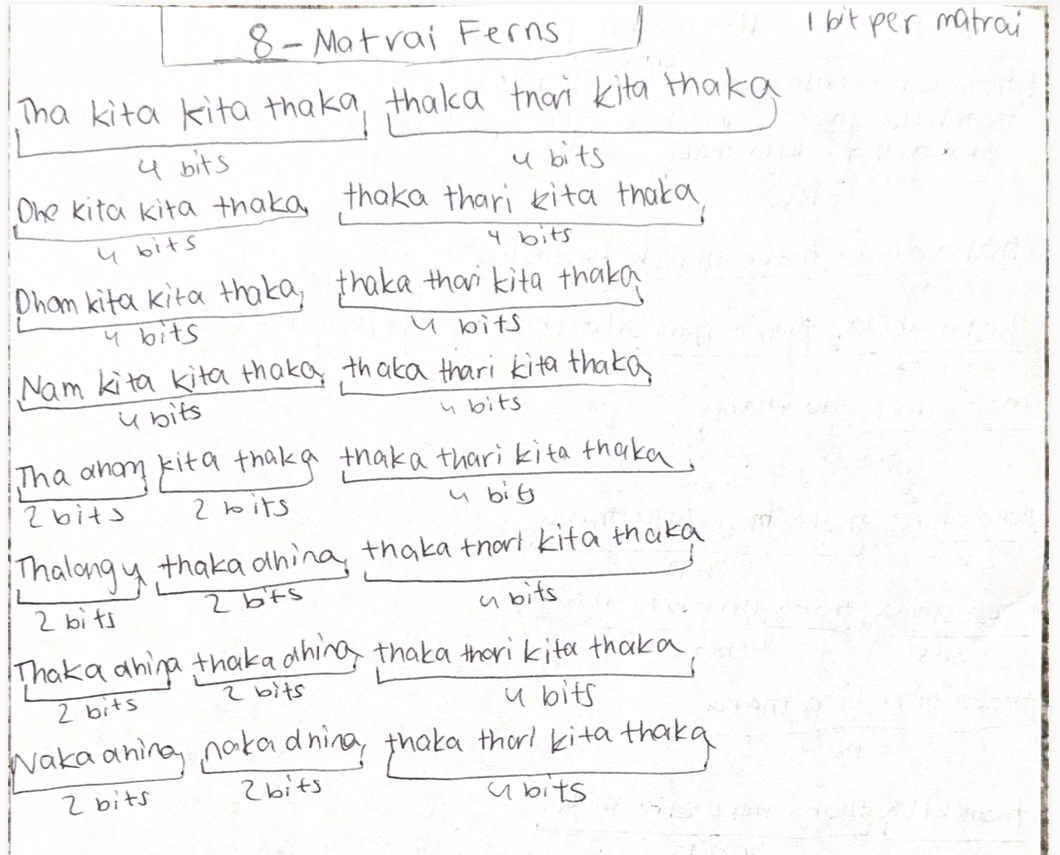
Download original handwritten notes (PDF):
Open PDF
Patterns I Learned (typed from my notes)
Each of the following patterns equals 8 matrais.
Tha kita kita taka | Thari kita taka (4 + 4)
Dhe kita kita thaka | Thaka thari kita thaka (4 + 4)
Nam kita kita taka | Thaka thari kita thaka (4 + 4)
Nam kita kita thaka | Thaka thari kita thaka (4 + 4)
Na dhin kita thaka (2)
Naka thari kita thaka (2 + 4)
Nakadhinga thakadhinga | Thaka thari kita thaka (2 + 2 + 4)
All patterns must add up to 8 matrais total.
Understanding the Structure
While learning this lesson, I noticed that even though the syllables change, the total number of matrais always stays the same.
There are many ways to make 8:
4 + 4
2 + 2 + 4
2 + 4 + 2
Different combinations are possible, but the total must remain balanced at 8. This showed me that rhythm has structure similar to counting and grouping in math.
Thinking in Units and Groups
When I was writing my notes, I started thinking of rhythm as grouped units.
2 matrai = small rhythmic group
4 matrai = half cycle
8 matrai = full cycle
So each rhythm line becomes: 4 + 4 = 8 or 2 + 2 + 4 = 8
This grouping helped me understand and remember patterns more clearly.
What Happens When Speed Changes?
In this lesson I also learned that rhythm can be played at different speeds.
If played faster:
 - counts divide into smaller grouped units
 - more strokes fit into the same cycle
If played slower:
- counts expand into larger grouped units
- each beat becomes longer
Even when speed changes, the structure must still total 8 matrais.
This showed me that rhythm also involves ideas similar to multiplication, division, and structured grouping.
Early Connections I Notice (Math & Logical Thinking)
While learning this lesson, I started noticing that rhythm follows structure and counting.
Each pattern must always total 8, even if the internal grouping changes.
For example:
4 + 4
2 + 2 + 4
different combinations but same total
This feels similar to math where different numbers can add up to the same result.
When speed changes: playing faster divides grouped counts playing slower expands grouped counts
This made me realize rhythm also uses ideas like multiplication, division, and structured grouping.
Even without knowing the sound of the rhythm, this structure can be understood purely through numbers and logical rules.
Simple Logical Model (Connecting Rhythm to Structure)
In this lesson, each rhythm line must fit into a fixed cycle:
Total cycle = 8 matrais
Some valid patterns:
- 4 + 4 = 8 ✔
- 2 + 2 + 4 = 8 ✔
- 2 + 2 + 2 + 2 = 8 ✔
If a pattern becomes:
- 4 + 4 + 2 = 10 ✘
It does not resolve correctly and must be adjusted.
This simple rule helped me see that rhythm follows logical and mathematical structure.
Every pattern must satisfy a constraint before it is complete.
Simple Logic Rule (for non-music readers)
In this lesson, each line must fit inside a fixed cycle:
- Total cycle = 8 matrais
- Pattern total = sum of grouped units (like 4+4 or 2+2+4)
If (pattern total) % 8 = 0 → the pattern resolves correctly.
If not → the pattern must be adjusted to land correctly.
What This Helped Me Realize
While practicing 8-matrai patterns, I began to notice that even when individual phrases change, the total structure must remain constant.
This showed me how a system can stay stable while its internal parts change. As long as all components fit correctly within the cycle, the structure works.
I started seeing this idea in many areas — structured problems, logical systems, and situations where different parts must fit within a fixed constraint. This way of thinking has helped me become more careful about patterns, alignment, and consistency.
Simple Structural Model
Total cycle = 8
Possible valid groupings:
- 4 + 4 = 8
- 2 + 2 + 4 = 8
- 1 + 3 + 4 = 8
If the total becomes greater or smaller than 8, the pattern does not resolve correctly and must be adjusted.
This helped me understand how structured systems depend on balance within fixed limits.
This lesson showed me that even simple rhythmic cycles follow clear structural rules, and understanding those rules helps me think more carefully about patterns and systems in general.
This made me realize that many real-world systems work the same way: they allow flexibility inside a fixed structure, but they still must satisfy the overall constraints to stay stable.
What My Teacher Explained About Structure
During this lesson, my teacher explained that in mridangam patterns we do not use a single isolated unit by itself. The rhythm must always be grouped into structured counts such as 2 or 4 matrais to maintain balance and flow.
This helped me understand that there is always a minimum valid grouping needed to form a stable rhythm pattern. A single unit by itself does not create a complete rhythmic structure in this lesson.
When I thought about this more, it reminded me of how systems in math and computer science also follow rules and constraints. In computing, data and instructions are usually organized into structured blocks instead of isolated single units, and systems must follow minimum valid groupings.
Seeing this idea in rhythm made me realize that both music and computing depend on structure, grouping, and valid patterns.
This lesson is my starting point in exploring how rhythm, math, computer science and logical thinking connect as I continue learning mridangam.
Music, Math, and Computer Science Connection
This lesson connects to mathematical and computational thinking.
See full connections here:
➡️ Music → Math → Computer Science Connections