rishi-vedula-mridangam-portfolio
Lesson 2: Understanding 16-Matrai in Mridangam
What is a 16-Matrai Pattern?
In Carnatic rhythm, a matrai is a unit of time or beat.
In this lesson, I practiced rhythm patterns where each line must total 16 matrais.
Compared to 8-matrai patterns, 16-matrai cycles are longer and require stronger internal counting and control.
Even though the syllables change, the total count must always remain 16.
This helped me understand how longer rhythmic cycles are structured and balanced.
My Lesson Notes
In this lesson, I wrote patterns to understand how different groupings combine to form 16 matrais.
I also started observing how longer cycles require more concentration to maintain timing and structure.
Each pattern must always total 16 matrais.
Original Handwritten Notes
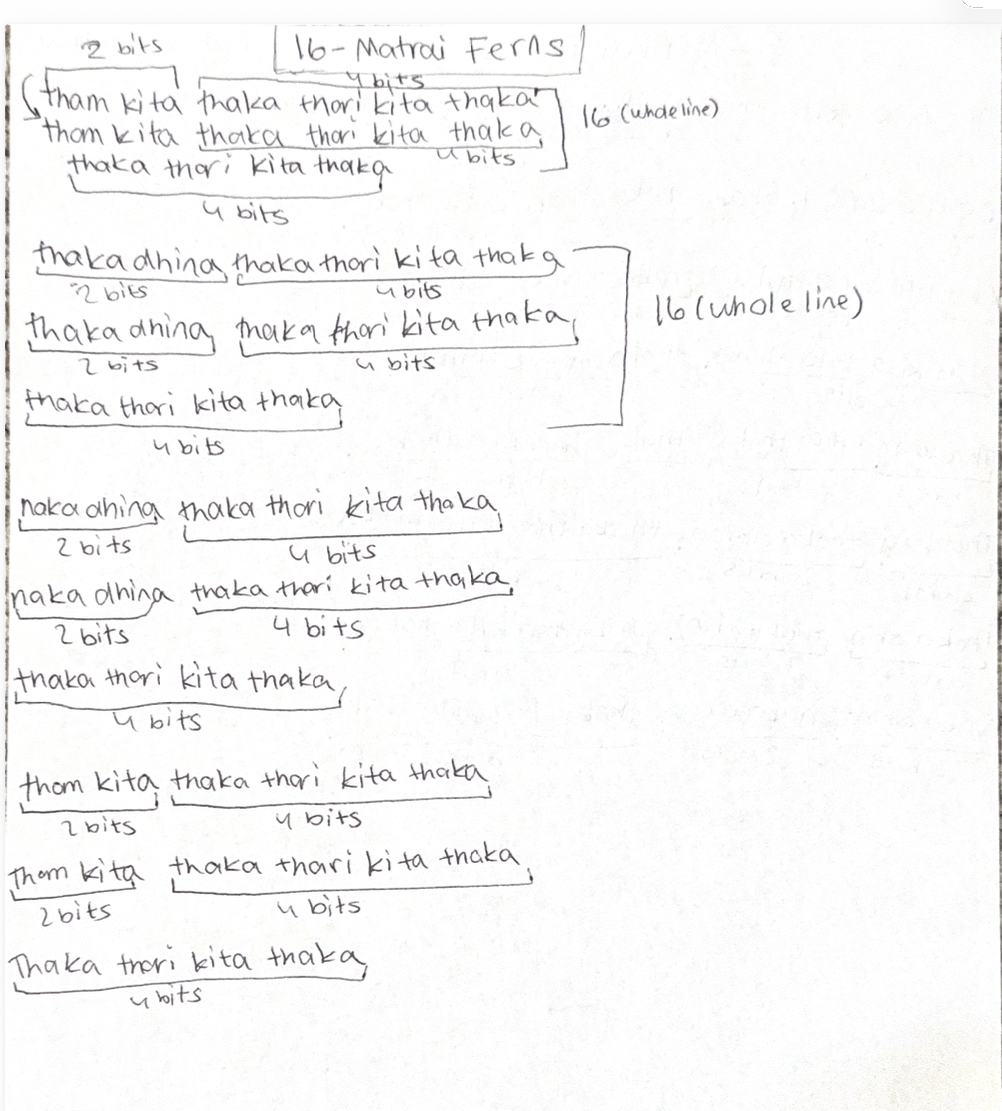
Download Original Notes (PDF)
Patterns I Learned (typed from my notes)
Each of the following patterns equals 16 matrais.
| Tham kita thaka thari kita thaka | Thom kita thaka thari kita thaka (8 + 8) |
| Thaka thari kita thaka | Thaka thari kita thaka | Thaka thari kita thaka | Thaka thari kita thaka (4 + 4 + 4 + 4) |
| Thaka dhina thaka thari kita thaka | Thaka dhina thaka thari kita thaka (8 + 8) |
| Naka dhina naka thari kita thaka | Naka dhina thaka thari kita thaka (8 + 8) |
| Thom kita thaka thari kita thaka | Thom kita thaka thari kita thaka (8 + 8) |
Each line completes one full 16-matrai cycle.
All patterns must total 16 matrais before repeating.
Understanding the Structure
While learning this lesson, I noticed that longer cycles require careful counting and spacing.
There are many ways to make 16:
8 + 8
4 + 4 + 4 + 4
2 + 2 + 4 + 8
Different combinations are possible, but the total must remain 16.
This showed me that rhythm has structure similar to grouping and counting in mathematics.
Thinking in Units and Groups
When writing these patterns, I began thinking of rhythm in grouped units:
2 matrai = small unit
4 matrai = structured grouping
8 matrai = half cycle
16 matrai = full cycle
Each rhythm line must complete the full 16-matrai cycle correctly.
What Happens When Speed Changes?
If played faster:
- more strokes fit into the same cycle
- counts divide into smaller internal units
If played slower:
- counts expand into longer units
- spacing between beats increases
Even when speed changes, the structure must still total 16 matrais.
Early Connections I Notice (Patterns & Logic)
While practicing 16-matrai patterns, I noticed that rhythm follows structure and counting rules.
Different groupings can create the same total:
8 + 8
4 + 4 + 4 + 4
2 + 2 + 4 + 8
This feels similar to mathematics where different combinations can produce the same result.
Maintaining rhythm requires:
- counting accuracy
- pattern recognition
- structured grouping
- consistency across cycles
Scaling the Structure from 8 to 16
In 16-matrai patterns, the cycle becomes twice as long as the 8-matrai structure.
Instead of thinking only in one layer (like 4 + 4), I now have to think in larger groupings such as:
8 + 8
4 + 4 + 4 + 4
2 + 2 + 4 + 4 + 4
This required me to hold a longer structure in my mind while still maintaining internal balance.
I realized that as systems grow larger, structure becomes even more important. Without clear grouping, it becomes difficult to maintain alignment across the full cycle.
Hierarchical Grouping
In 16-matrai rhythm, I began to see that patterns can be organized in layers.
For example:
16-matrai cycle
→ two 8-matrai halves
→ each half can contain 4 + 4
→ each 4 can contain 2 + 2
This showed me that rhythm can be structured in levels, where smaller units build into larger systems.
Understanding these layers helped me think more clearly about how complex structures are formed from simple building blocks.
Structural Logic of 16 Matrai
In this lesson, the total cycle expands to 16 matrais.
This helped me see how rhythmic structure scales while still following clear rules.
Some valid structures:
- 8 + 8 = 16
- 4 + 4 + 4 + 4 = 16
- 2 + 2 + 4 + 8 = 16
Even when internal groupings change, the total must remain 16.
If a pattern exceeds or falls short of 16, it does not resolve correctly and must be adjusted.
This showed me that rhythm follows the same kind of structural logic used in mathematics:
- working with multiples
- grouping within a fixed total
-
validating whether a structure fits a defined constraint
- This also helped me understand how larger structures can be built from smaller repeating units while still maintaining an overall constraint.
Simple Logical Model
If I think of 16 matrai as a fixed structure:
Total cycle = 16
Some valid patterns:
- 8 + 8 = 16 ✔
- 4 + 4 + 4 + 4 = 16 ✔
- 2 + 2 + 4 + 8 = 16 ✔
If a pattern becomes:
- 8 + 8 + 2 = 18 ✘
It does not resolve correctly and must be adjusted.
This helped me see that longer rhythmic cycles follow the same kind of structural rules used in mathematics and logical systems.
What This Helped Me Realize
Moving from 8-matrai to 16-matrai made me realize that as structures become larger, they require more planning and organization.
It is easier to manage small systems, but longer cycles require thinking ahead and maintaining alignment across multiple layers.
This experience strengthened my ability to think about structure over longer sequences rather than focusing only on short segments.
What My Teacher Explained
My teacher explained that longer cycles like 16 matrais require strong internal counting and control.
Each pattern must resolve correctly at the end of the cycle and return to the starting point.
This reinforced the importance of structure, grouping, and balance in rhythm.
Music, Math, and Computer Science Connection
This lesson connects to mathematical and computational thinking.
See full connections here:
➡️ Music → Math → Computer Science Connections